Hello everyone! Today, I’m back with another riveting adventure into the quantum world. First, let’s learn about the umbrella term of this part of physics. Quantum mechanics is an assortment of many topics, and in some ways can be very weird! Quantum mechanics is our future, ranging from quantum computers, allowing humans to solve questions that would take typical supercomputers many years, all the way to quantum cryptography, not allowing hackers to take any information.

Delving into the Quantum Realm: Exploring Techniques for Particle Entanglement
Before we delve into this interesting topic, we should know how to entangle two quantum particles in the first place. This can be done most simply by entangling them by birth. We can bring the atoms close and let them interact with each other. And then, if you put one particle in superposition, the other will also be in superposition. Like this, the wave functions of the two particles are the same. And since their wave functions are the same, mathematically, they are the same.
Understanding the Fundamentals of Quantum Entanglement
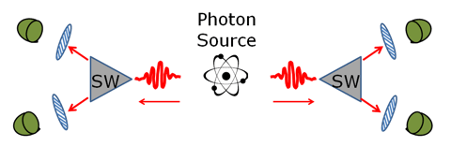
Now, let’s clarify some basic concepts: In quantum mechanics, the angular momentum of a particle is called its spin. Firstly, there is wave-particle duality. This is when quantum objects can be represented as a wave function (λ) or can be represented as a particle. Then, there is quantum superposition, the ability of a particle to be in multiple states until measured. And now, our topic- Quantum Entanglement. This part of quantum mechanics deals with mixing wave functions of particles of quantum objects. Now let’s consider that we have an electron-entangling device, and I entangle 2 electrons. If electron 1 has a spin down, then it instantaneously alters the spin of electron 2, setting its spin upwards. If we measure one particle, the other one’s properties are affected instantly, as opposed to Einstein’s Special Theory of Relativity
Quantum Superposition
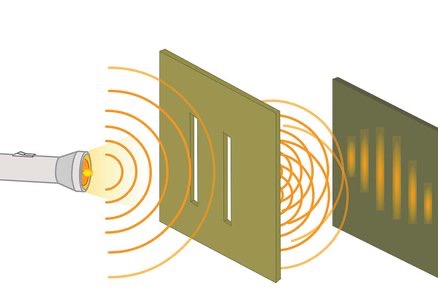
Now, let’s entangle another pair of electrons. Now, let’s shoot them far away from each other. Remember, we still have not measured thus, we don’t know any of the spins. As soon as we make a measurement, we will know the spin of both particles. Considering that we make a pair of electrons, both electrons are in a superposition, meaning that the particle could be in a spin-up or spin-down position at any moment. The electron’s spin is not determined before a measurement is made. It’s not that we don’t know it, but there is no definitive answer until we determine it. A way we can prove superposition is by the double-slit experiment. If no measurement was made in the room, and electrons were fired, then an interference pattern would be created, inferring that it is a wave. On the other hand, when a measurement was made, the particles became localised behind the slits.

Bell’s Inequality: The Battle for Righteousness
Now, you could be thinking that the spins could be predefined, and if you think that way, our thoughts match with Einstein’s. Einstein, with his fellow scientists. They were trying to say that the universe had pre-defined the spin of 2 entangled particles. However, many scientists were against the theory. And the smart mind of John Bell knew exactly what to do. He used his smart mind and inequality principle, commonly known as Bell’s Inequality. By using Bell’s Inequality Principle, he realised that Einstein was wrong.

Quantum Entanglement: The Various Applications and Uses
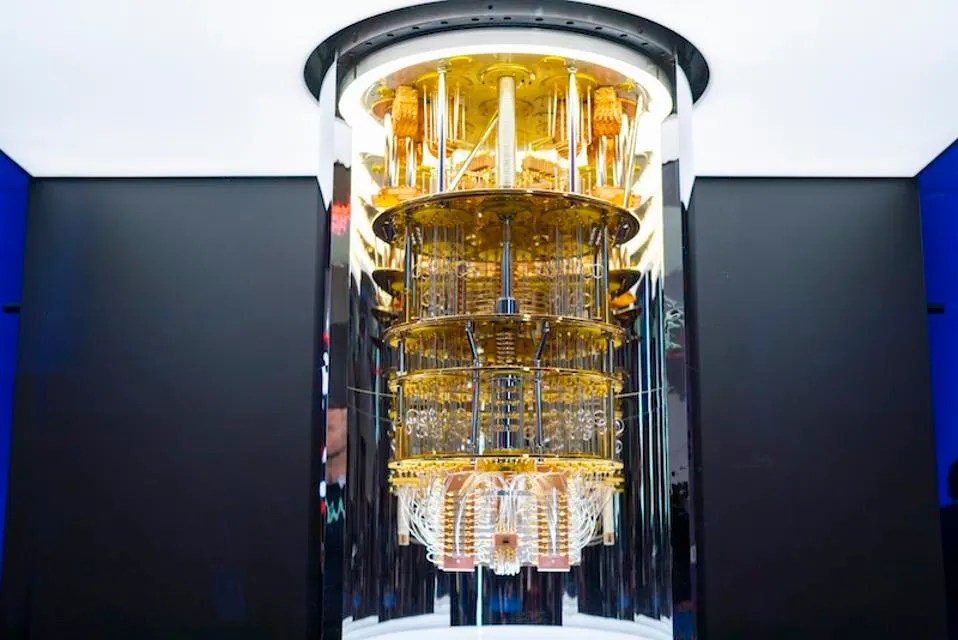
There are various applications of quantum entanglement, like the use of quantum computers. These are the latest, most cutting-edge technology. Normal computers, like the one you are most likely reading this blog on (because you could be reading this on a quantum computer), use bits to process information. In bits, you can either have ‘1’ or ‘0’. In simple words, your bits can be only in 2 states, either on or off. However, quantum computers have Q-bits. Q-bits not only consist of a state of on and off but rather everything in between. This allows quantum computers to be able to perform massive calculations that might as well take an advanced supercomputer millions of years in mere minutes.
Conclusion: Infinite Possibilities with Quantum Mechanics
So, in conclusion, quantum physics is the weirdest branch of physics but also the most accurate. The majority of things that quantum physics is applied to turn out to match observations precisely. Furthermore, there are many applications of this spooky branch of physics, which have led to various discoveries. This branch of physics is truly mind-boggling!

 The Physics Phenomenon
Leave a comment