Hello, and welcome back to the Physics Phenomenon. I am Arav Bhasin (if you have not already known), and I love Mathematics and Physics.
Today, let’s delve into the chilling phenomenon that exists in the vastness of space. These cosmic anomalies never fail to spark awe and fear within me. As predicted by Einstein’s General Theory of Relativity, these immense entities possess an irresistible gravitational pull, consuming anything that comes too close. Even light itself cannot escape their gravitational fields, making them truly formidable. These cosmic anomalies are none other than mysterious black holes.
How are Black Holes Formed?
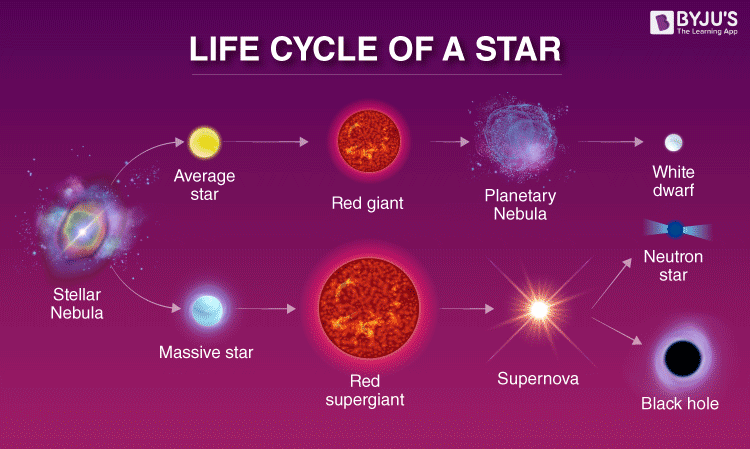
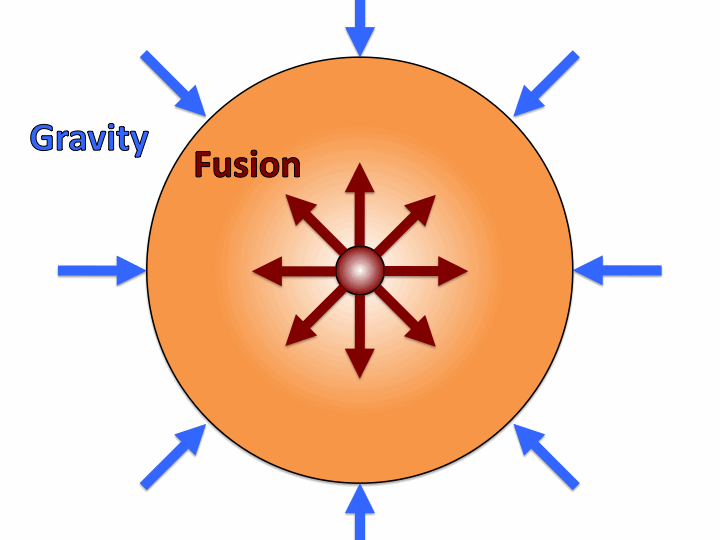
Black holes are the result of dead stars being compressed to the point of infinite density and gravity. Inside a star, two processes are constantly at play. Firstly, there’s nuclear fusion, where hydrogen fuses to form helium under extreme heat and pressure, creating an outward force. To balance this force, there’s an inward force: gravity. Without this inward force, the star would explode due to the unopposed outward force of nuclear fusion. This process is known as hydrostatic equilibrium. When a star runs out of fuel for nuclear fusion, there’s no force to counteract gravity, leading to a supernova explosion and the formation of a black hole.
Not all stars turn into black holes when they die. According to Indian physicist and mathematician Chandrasekhar, there’s a limit beyond which a star will become a black hole. This limit, known as the Chandrasekhar limit, is precisely 1.4 times the mass of our sun. If a star’s mass reaches this threshold, it will collapse into a black hole.
Parts of a Black Hole
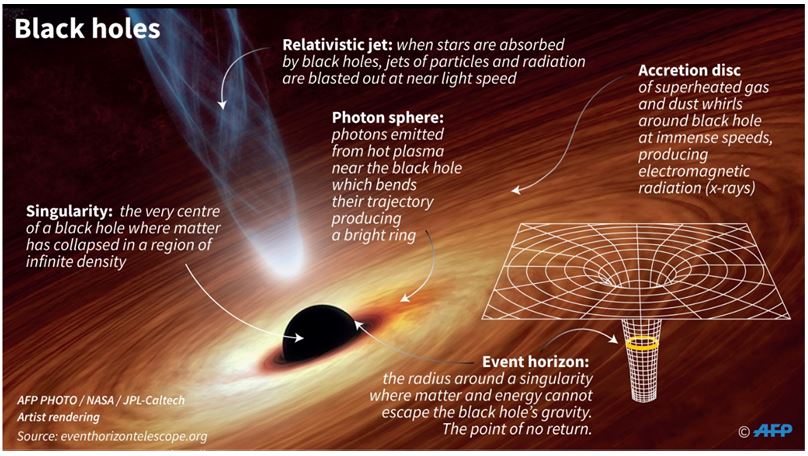
At the core of a black hole lies the singularity, where gravity is so intense that it causes space-time to curve infinitely. Surrounding the singularity is the event horizon, known as the “point of no return,” beyond which nothing, not even light, can escape. Beyond the event horizon is the ergosphere, where the black hole’s rotation drags around the space-time continuum. If the black hole has an accretion disk, it forms from matter spiralling into the black hole, heating up and emitting X-rays and other radiation. Some black holes also have jets, massive streams of particles that are expelled from the poles at nearly the speed of light. Each of these components plays a crucial role in how these enigmatic objects interact with the universe.
Life of a Black Hole
In the middle stage of a black hole’s life, it experiences stability and continuous growth. After forming from the collapse of a massive star or the merging of smaller black holes, a black hole enters a phase where it actively attracts nearby matter and energy. This process, known as accretion, involves the black hole’s powerful gravitational pull drawing in gas, dust, and sometimes entire stars from its surroundings. As this material spirals toward the event horizon, it forms an accretion disk, heating up and emitting radiation, often observed as X-rays. During this phase, the black hole’s mass can increase significantly, especially in active galactic centers, where supermassive black holes consume large amounts of matter. Over time, the rate of accretion may slow down as the black hole depletes the available material. Nonetheless, the black hole remains the dominant gravitational force within its region of space.
How Does a Black Hole Die?
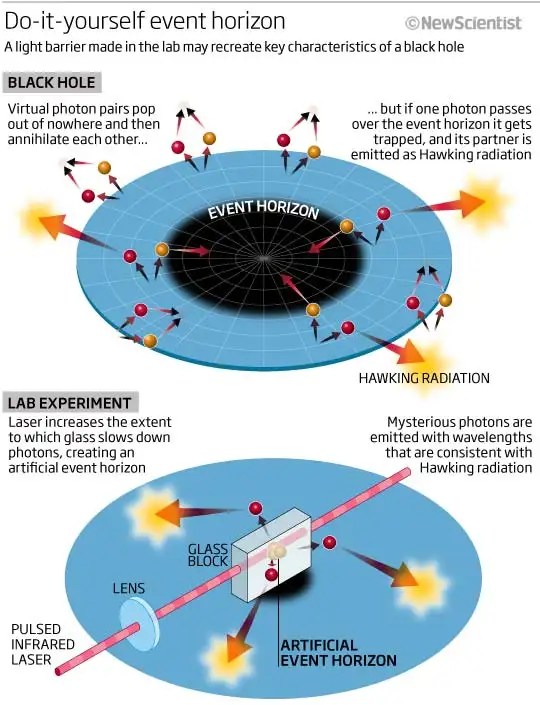
Hawking radiation is a groundbreaking concept in theoretical physics proposed by renowned physicist Stephen Hawking. According to this theory, black holes are not entirely black but instead emit faint radiation due to quantum effects near the event horizon. This radiation occurs due to the principle of uncertainty. You can never be 100% certain if there is a particle or not. These particles are generated from the gravitational energy of a black hole. There is a particle and an anti-particle generated at the event horizon. What Hawking suggested was that one particle or anti-particle escapes. This radiation is now known as Hawking radiation. As a result, over an extremely long time, black holes can lose mass and eventually evaporate. This revolutionary idea challenged the normal belief that nothing could escape from a black hole, and it has various implications for our understanding of the behaviour of black holes.
Conclusion
In conclusion, black holes are truly fascinating and mysterious entities that continue to captivate the imagination of scientists and enthusiasts. From their formation to their potential demise, the journey of a black hole is filled with extraordinary phenomena that challenge our understanding of the universe. The study of black holes not only tells us about the extreme conditions of gravity and space-time but also presents us with profound questions about the nature of the cosmos. As we continue to unravel the secrets of black holes, we may gain deeper insights into the fundamental forces that govern the universe and our place within it. I hope you enjoyed, and stay tuned for more physics and fun!

 The Physics Phenomenon
Leave a comment