Hello everyone! I’m Arav, and I’m thrilled to be back with another deep dive into one of the universe’s most mind-bending phenomena. Imagine this: colossal cosmic events—like black holes colliding or neutron stars merging—sending ripples through the very fabric of space-time. These ripples aren’t just theoretical curiosities; they are real, detectable, and utterly awe-inspiring. If you haven’t guessed already, today we’re exploring gravitational waves—disturbances in space-time that revolutionised modern physics. Let’s unravel the science behind these cosmic marvels!
Key Concepts Before We Begin
To truly grasp gravitational waves, let’s first understand two fundamental ideas:
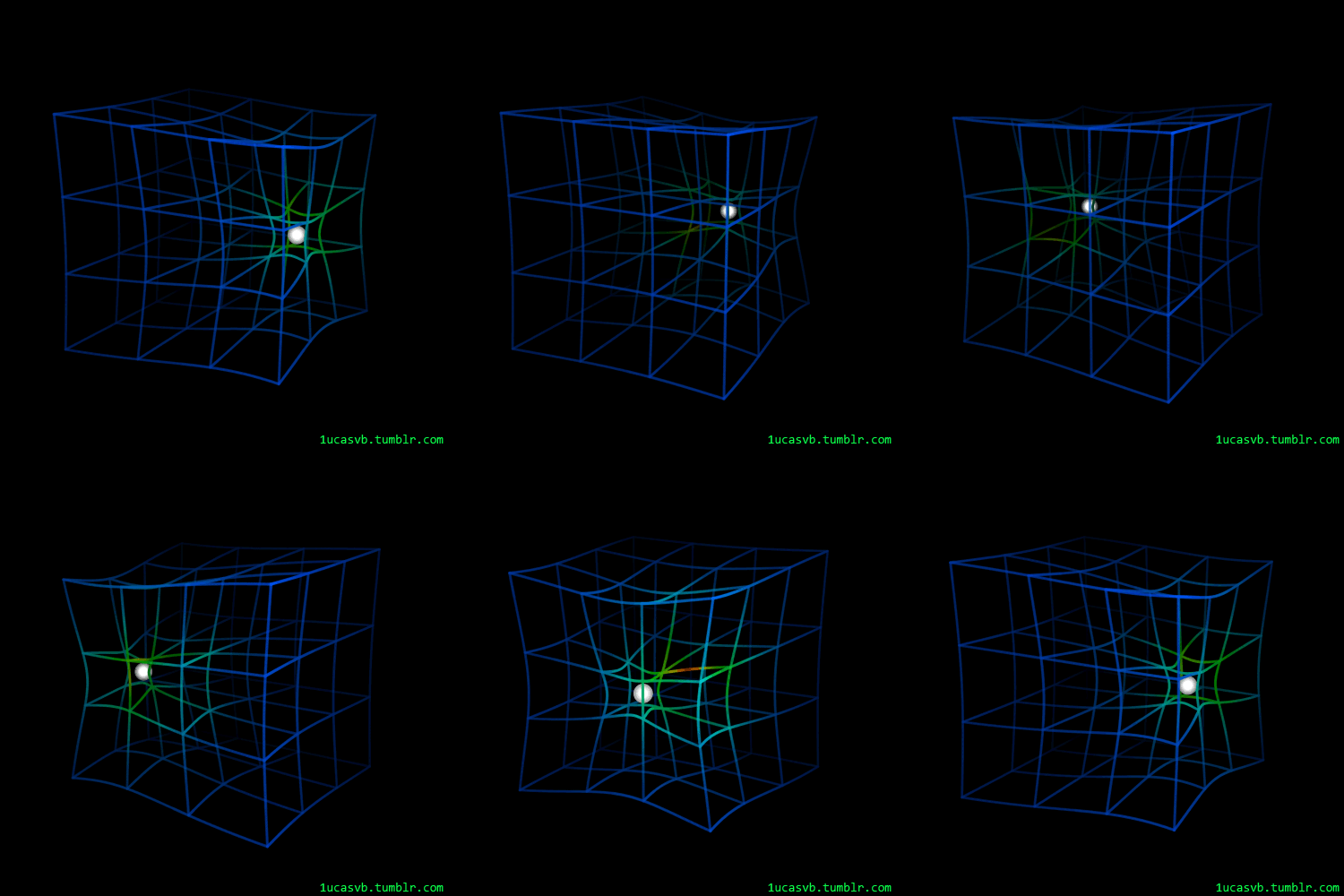
- Space-Time: Picture space-time as an invisible, four-dimensional fabric woven from the three spatial dimensions (x, y, z) and time. Every massive object bends this fabric, creating what we perceive as gravity.
- Gravity: According to Einstein’s General Theory of Relativity, gravity is not a force pulling objects together but rather the distortion of space-time itself. The greater the mass, the deeper the curvature it creates.
What Are Gravitational Waves?
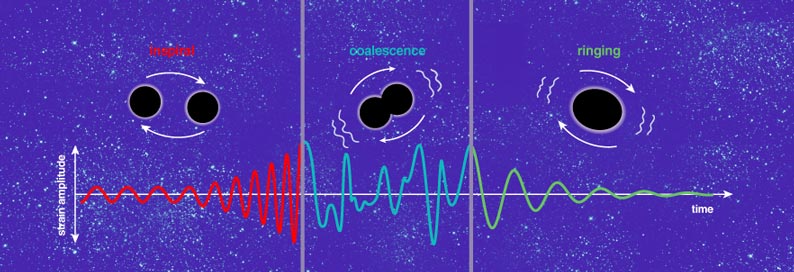
Gravitational waves are ripples in space-time caused by incredibly energetic cosmic events. They arise when massive objects—like neutron stars or black holes—accelerate or collide. Even supernovae, the explosive deaths of stars, can generate these waves.
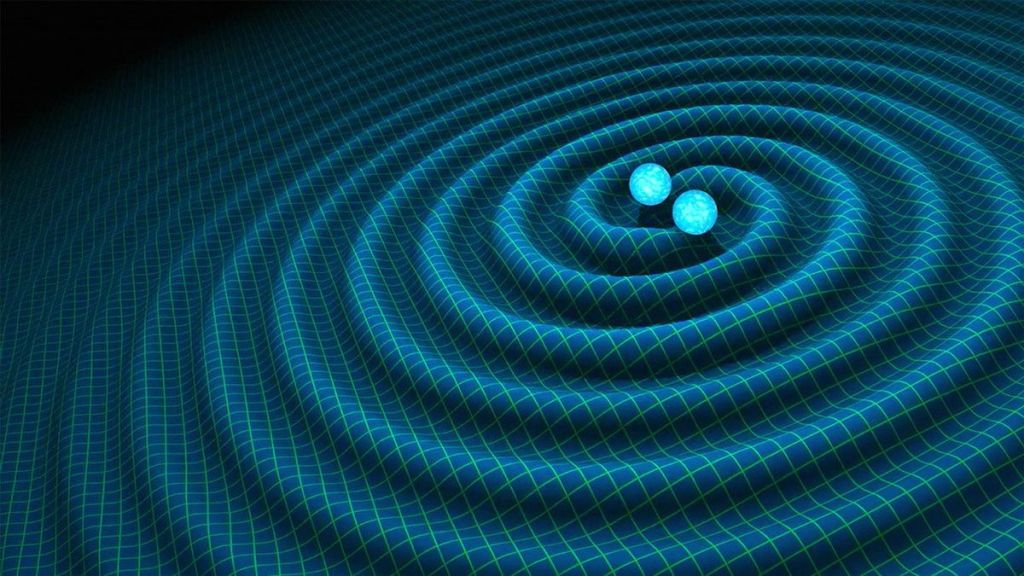
Think of two balls placed in a bucket of water. If you swirl them around each other, they create ripples that spread outward. Here, the water represents space-time, the balls represent massive celestial bodies, and the ripples are gravitational waves travelling across the universe.
The Discovery of Gravitational Waves
Although Einstein predicted gravitational waves in 1916 as part of his General Theory of Relativity, it wasn’t until 1974 that indirect evidence surfaced. Astronomers Russell Hulse and Joseph Taylor discovered a binary pulsar—two neutron stars orbiting each other—21,000 light-years from Earth. Observing how their orbit changed over time, they confirmed that energy was being lost at precisely the rate Einstein’s equations predicted—strong evidence of gravitational waves.
However, it wasn’t until 2015 that the Laser Interferometer Gravitational-Wave Observatory (LIGO) directly detected them for the first time, proving Einstein right after nearly a century!

Defining Characteristics of Gravitational Waves
Like any wave (longitudinal), gravitational waves have distinct properties:
- Medium: Just as sound waves travel through air and water waves through water, gravitational waves propagate through space-time itself.
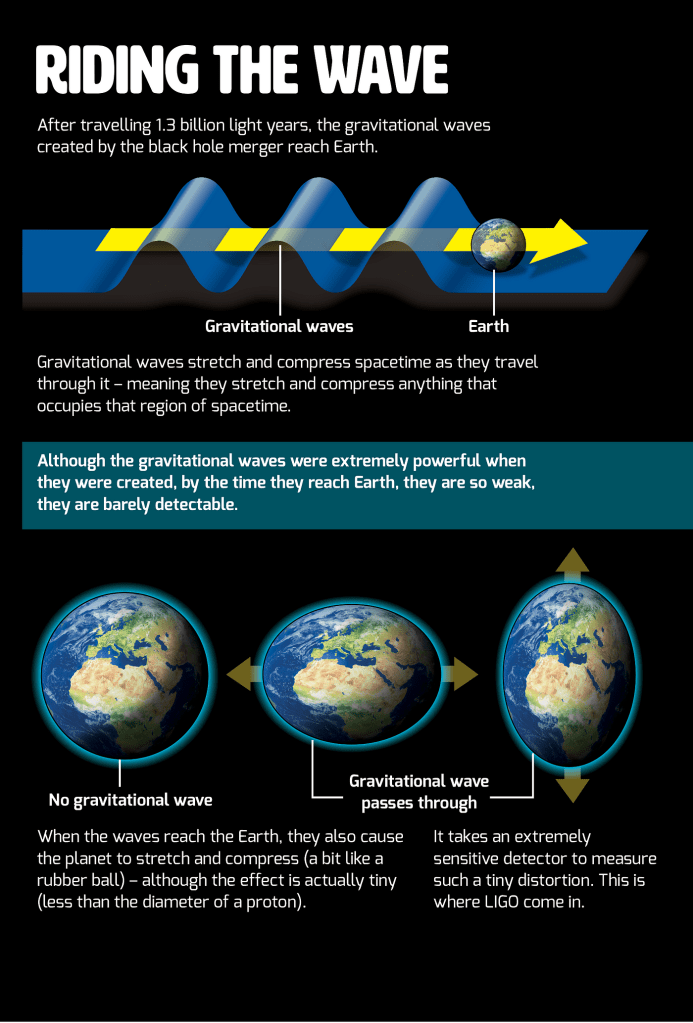
- Amplitude: These waves stretch and compress anything they pass through. The stronger the wave, the greater the distortion.
- Frequency: Measured in Hertz (Hz), this tells us how fast the waves arrive. Some waves pass hundreds of times per second, while others take years.
- Wavelength: The distance between peaks of a wave can range from a few kilometers to millions of kilometers, depending on the source.
How Do We Detect Gravitational Waves?
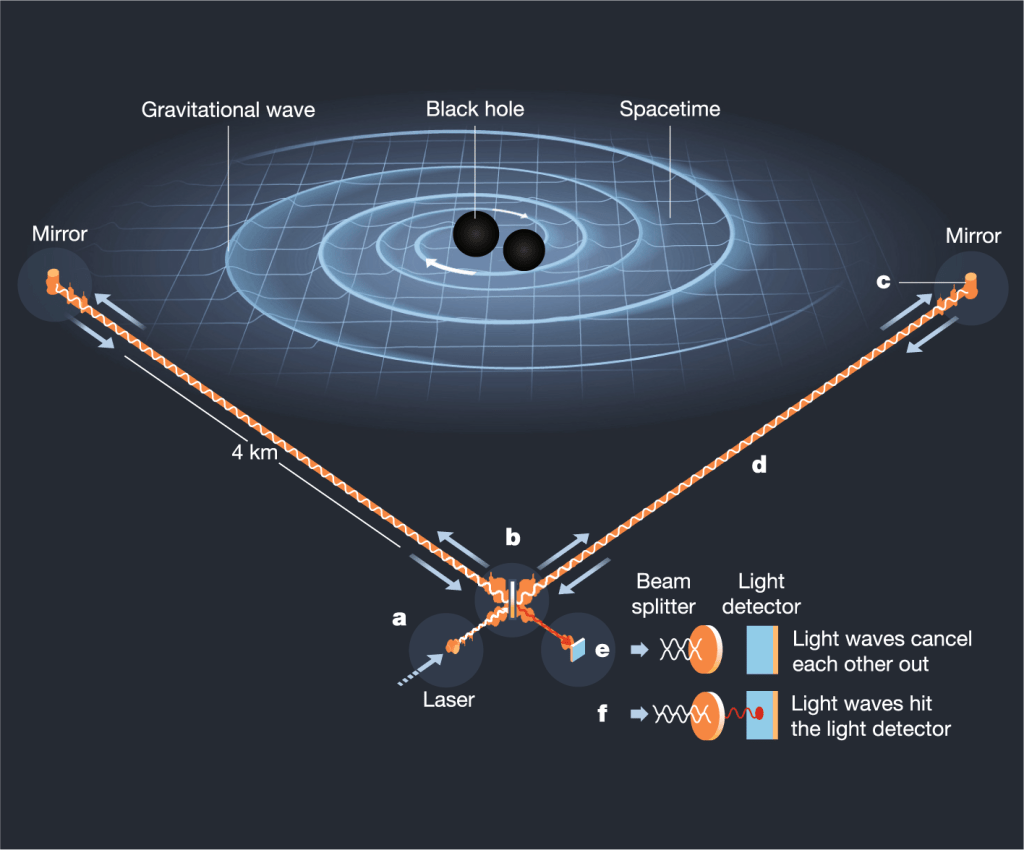
Detecting gravitational waves is incredibly challenging because they stretch and squeeze space-time by minuscule amounts—far smaller than the width of an atom. Enter LIGO (Laser Interferometer Gravitational-Wave Observatory), one of the most sensitive scientific instruments ever built.
LIGO consists of two long tunnels, each 4 km in length, arranged in an L-shape. A laser beam is split into two and sent down both tunnels, bouncing off mirrors at the ends before returning. Under normal conditions, the laser beams cancel each other out. However, when a gravitational wave passes through, it stretches one tunnel while squeezing the other, causing a tiny shift in the returning beams. This minute disturbance is what LIGO detects.
Since these distortions are incredibly small, multiple detectors worldwide work together to confirm that the waves are real and not local disturbances like earthquakes.
Conclusion
Gravitational waves represent one of the greatest discoveries in modern physics, giving us a revolutionary way to observe the universe. From Einstein’s predictions in 1916 to LIGO’s first detection in 2015, these space-time ripples have opened up new frontiers in astrophysics. They allow us to study the most powerful and enigmatic cosmic events, from black hole mergers to supernovae.
As detection technology advances, we may soon uncover even more secrets about the universe. Gravitational waves challenge our understanding of space and time, but they also inspire a deep sense of wonder about the vast, dynamic cosmos we call home. Let’s keep exploring and unraveling the mysteries of the universe together!

 The Physics Phenomenon
Leave a comment