Introduction
Hello and welcome back to the Physics Phenomenon. If you are new here, the Physics Phenomenon is my safe space to share my ideas and blogs open for everyone to read.
Today, I will be delving into one of the bravest and most ambitious propositions in all of physics – String Theory. For what feels like forever, physics has been split down the middle into defining theories: General Relativity and Quantum Field Theory. General Relativity governs the motion of celestial bodies and the large-scale structure of the universe. It describes the universe as a stretchable fabric with 3 spatial dimensions, and one temporal dimension. This fabric can bend, causing objects to follow the curvature of the space-time continuum, thus creating not a force of gravity, but the underlying geometry of gravity.
Now, the other pillar of modern physics is Quantum Field Theory (QFT). This theory describes the quantum behavior of particles and fields. While General Relativity is the best theory for gravity, QFT is our most successful framework for describing three of the four fundamental forces. Within the framework of QFT, we build the Standard Model, which contains all the elementary particles like quarks, bosons and leptons. QFT describes almost every fundamental force as an exchange of particles. Electromagnetism is mediated by the exchange of photons while the weak force is carried by the exchange of W and Z Bosons. Lastly, the strong force is mediated by the exchange of gluons (Yes they sound like the word ‘glue’ as that is exactly what they do. They ‘glue’ the nucleus of an atom together).
And this is exactly where string theory comes into play. It unites gravity and QFT into one singular theory.
Why two of the Best Theories we have don’t work Together
The reason we have string theory is because no matter how hard we try, we simply cannot make GR and QFT gel together. Firstly, this is because GR is a classical theory, meaning that it describes the world as smooth, continuous, and predictable, without accounting for quantum effects. Meanwhile, QFT is a quantum theory, which describes the behavior of particles and energy at tiny scales, where outcomes are probabilistic and particles can act like both waves and particles. Secondly, when you try to integrate gravity into QFT, results produce infinities, making it impossible to renormalise it. The reason you can’t renormalise it is because the calculations give infinite types of infinities, as renormalisation only works if you can absorb all the infinities into a physical set of physical constants. Lastly, at extremely tiny distances, much smaller than an atom, around the Planck length (10^-33 meters), the smooth picture of spacetime from General Relativity no longer works. At the same time, the quantum rules of particles from QFT start giving nonsensical, infinite results. This is the one point at which both QFT and GR break down. And this exactly why we need string theory.
What is String Theory?
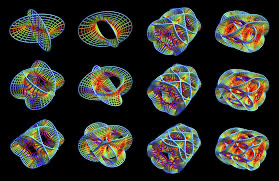
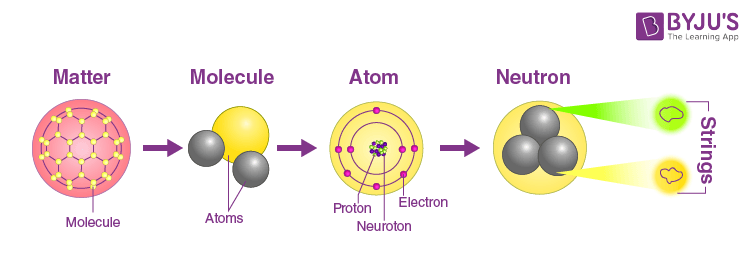
String theory is one of the theories physicists have come up with to form a Theory of Everything. This theory would be able to unify all the fundamental forces, including gravity, electromagnetism, weak force and strong force. So string theory postulates that in the smallest scales, 1 dimensional strings vibrate at different frequencies, making up different particles. One of the issues that is offered by string theory is that the math is only stable in above 10 dimensions. But this problem can be solved by the Calabi-Yau Manifold. This sort of compactifies all the extra dimensions into a manifold. Physcists hypothesise that as you zoom in further, you see more dimensions. For example, if you look at a straw from far away, you will see only one dimension, but zoom in further, and you will see that there are 2 dimensions. And stand right in front of it, and you will see a 3-dimensional object. This is what scientists speculate what could be happening. As you zoom in further, you will see more and more dimensions, compactified into the Calabi-Yau Manifold. Now that we know what string theory actually proposes, we can look at why this idea is so powerful and what advantages it offers. This idea of vibrating, 1-dimensional strings naturally brings many advantages to the table.
Open and Closed Strings
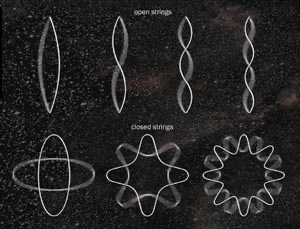
Open strings are one dimensional strings with two endpoints that can move and vibrate freely, giving rise to a variety of particle types depending on their vibration patterns, while closed strings are also one dimensional, but are loop like strings with no endpoints whose continuous, unbroken vibrations can produce particles such as the graviton and other closed-string excitations.
| Open Strings | Closed Strings | |
| Shape | A line segment with two endpoints | A loop with no endpoints |
| Typical Forces They Describe | Often linked to the non-gravitational forces like electromagnetism, weak force and strong force | Naturally linked to gravity, where one vibration mode is a graviton |
| Movement | Their ends can only move in certain ways | Freely move in all directions |
| Vibrational Modes | Produce particles that behave like gauge bosons | One mode always has spin-2, matching gravity |
Another very important difference is that open strings have two endpoints that must attach to D-branes, so they stay confined to these multidimensional surfaces and give rise to the particles and forces that live on them. Closed strings, on the other hand, form loops with no endpoints, allowing them to travel through the higher-dimensional bulk — and one of their vibration modes naturally behaves like the graviton.
What is a D-Brane
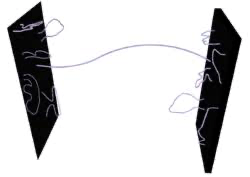
D-branes are multidimensional surfaces that open strings can attach to. While closed strings move freely through the higher dimensional space, open strings must have endpoints fixed onto these D-branes. These branes can have many dimensions—for example, a D0-brane is like a point, a D1-brane is like a string, and a D2-brane is a membrane. What makes D-branes so important is that the vibrations of open strings living on them can behave like the particles and forces we observe, meaning entire universes or physical laws could exist on the surface of these branes. In many versions of string theory, our own universe may itself be a D-brane floating in higher-dimensional space, with only gravity (carried by closed strings) able to move off the brane and into the extra dimensions.
Advantages of String Theory
String theory is one of our best descriptions of the universe. While it may be complex, it does come with many advantages. Firstly, it is unneccesary to forcefully incorporate gravity into it, as there is a mathematically stable string with a mass of zero and a spin of 2. This is extremely important, as these are the properties needed for a fully attractive particle (If you want more information about this, please check out my blog of gravitons). Secondly, string theorydoes not produce infinities, making it a possible and viable theory. With this, string theory has the potential to unite all the 4 fundamnetal forces under only one framework. Not only this, while the mathematics may seem complex, the extra dimensions can be compactified. Along with all of this, it does not break at extreme scenarios like near Planck Length. They also remove point particle problems, which cause cause the interactions to spread out, thus preventing an infinity issues. Another advantage is that string theory naturally includes supersymmetry, a symmetry that pairs particles together and helps stabilise the theory at high energies.
Conclusion
In this blog, we explored why General Relativity and Quantum Field Theory, our strongest ideas in physics, fall apart when pushed to the smallest scales. String theory steps in with a solution of having one dimensional tiny vibrating strings that create every particle and every force, including gravity. We looked at extra dimensions curled up in Calabi–Yau manifolds, the roles of open and closed strings, and how D-branes act as the surfaces where strings live. But even with all these ideas, one big mystery remains: if the universe is made of strings and hidden dimensions, how much of reality are we still blind to?

 The Physics Phenomenon
Leave a comment