Hello and welcome back to the Physics Phenomenon. If you are new here, the Physics Phenomenon is my safe space to share my ideas and blogs open for everyone to read.
Ever wonder why your textbooks always said “Electromagnetism” and not two different chapters for electricty and magnetism? Well, this is thanks to Maxwell’s equations, which united light, electricity and magnetism under the same umbrella term: “Electromagnetism”. Maxwell’s four equations are the literal definition of genius. These 4 equations revealed that electricity, magnetism and light are depply interconnected. The term “Electromagnetic wave” also originates from his 4 equations. Not only did his equations find the interconnection between 3 topics, it laid the foundation for many breakthroughs in technology, all the way from radios to Wi-Fi.
A Little History…
James Clerck Maxwell was a Scottish physicist born in Edinburgh. Maxwell was intrigued by patterns in nature and mathematical descriptions of physical phenomena. At the ripe age of 14, he published his first paper On the Description of Oval Curves. Soon thereafter, he started writing papers linking electricty and magnetism together inspired by Faraday’s Law. He publishes his next big paper On Physical Lines of Force, where he first started developing the mathemtics to link all these theories together. Maxwell published A Dynamical Theory of the Electromagnetic Field, presenting the full framework that unifies electricity, magnetism, and light. His work includes the crucial “displacement current term,” which completes the symmetry of electromagnetism. He consolidated all of this information into one paper called Treatise on Electricity and Magnetism.
His First Two Equations
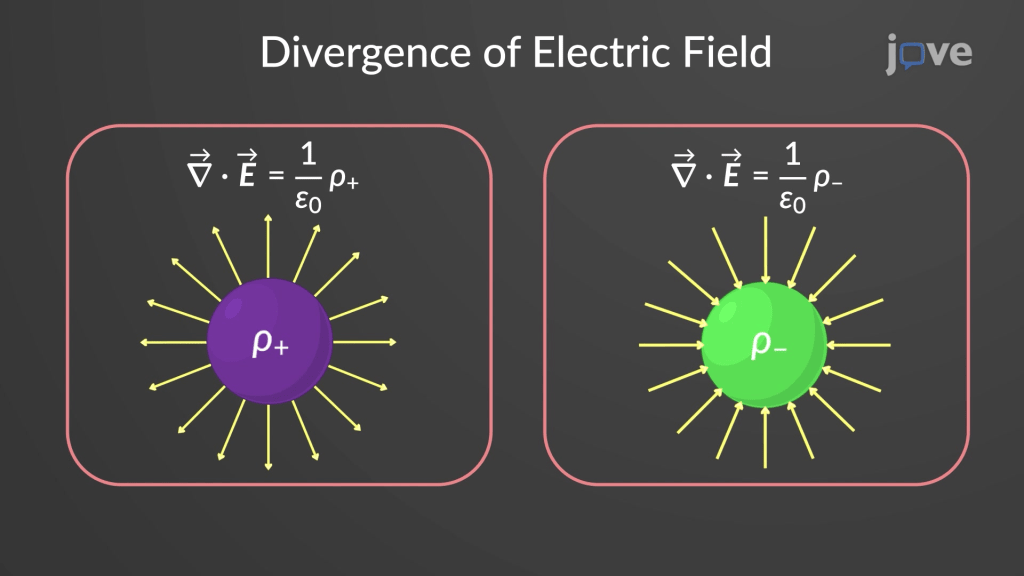
Maxwell’s first two equations describe where electric and magnetic fields come from. The first one called Gauss’s Law for electricity says that if you look at how much an electric field diverges in a vector field (The upside down triangle is the symbol for divergence) from a region, that amount tells you how much electric charge is inside. In math this is written using something called divergence of the electric field, and it equals the charge density divided by a constant. The second equation, Gauss’s Law for magnetism, says that if you try to measure how much a magnetic field spreads out in the same way, you always get zero. Mathematically its divergence is zero. This means magnetic field lines never start or end, but they always form loops, which is why it is impossible to have a magnetic monopole. Together, these two equations explain the static structure of electromagnetic fields: electric fields can originate from charges, but magnetic fields cannot originate from isolated poles.
The Next Two Equations
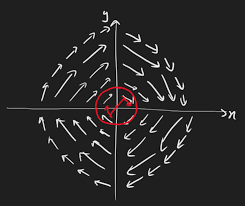
Maxwell’s third and fourth equations describe the dynamic nature of electromagnetism: how electric and magnetic fields continually create each other when they change. Faraday’s Law says that if a magnetic field changes over time, the math shows that its curl (a measure of how much the electric field loops around) becomes non-zero. In simple terms, a changing magnetic field produces a circulating electric field. The fourth equation, the Ampère–Maxwell Law, is the mirror image of this idea: it says that the curl of the magnetic field depends not only on electric currents but also on how quickly the electric field itself changes. Maxwell added this extra term, because without it, the equation broke down when electric fields changed, so he added the term to fix the inconsistency and show that changing electric fields can create magnetic fields. Together, these two equations show that a changing magnetic field produces electricity, and a changing electric field produces magnetism, creating a self-sustaining cycle that allows electromagnetic waves on the EM spectrum to exist.
Applications of Maxwell’s Equations
Maxwell’s Equations, which may seem useful only for theoretical purposes, serves many purposes in the real world. Some example are:
Predicting electromagnetic waves: Maxwell’s discovery that changing electric and magnetic fields sustain each other directly led to the understanding that light is an electromagnetic wave. This forms the foundation of all technologies that use EM waves.
Wireless communication: Since Maxwell’s equations explain how antennas create and receive electromagnetic waves, they make possible every wireless system: radio broadcasting, Wi Fi routers, Bluetooth devices, GPS, and mobile phone networks.
Electric power generation and transformers: Faraday’s Law explains how changing magnetic fields induce electric currents, which is the principle behind generators in power plants and transformers that step voltages up or down for safe power distribution.
Electric motors and actuators: The equations describe how magnetic fields are produced by currents and how they exert forces, forming the working principle of motors, fans, hard drives, pumps, and almost any device that converts electricity into mechanical motion.
Optics and modern imaging: Since Maxwell showed that light obeys the same equations as radio waves, the entire field of optics — lenses, lasers, fiber-optic communication, spectroscopy, and even cameras — rests on Maxwell’s unification of light with electromagnetism.
Medical technologies: MRI scanners rely on precise control of magnetic fields and radio waves, both governed by Maxwell’s equations, to create detailed images of the body without radiation.
Conclusion
From Maxwell’s early genius to his revolutionary unification of electricity and magnetism, we’ve seen how his four equations reshape our understanding of the physical world. The first two equations showed how electric charges create electric fields and why magnetic fields never originate from isolated poles. The next two revealed the real magic: changing magnetic fields create electric fields, and changing electric fields create magnetic fields, forming the engine behind electromagnetic waves. These ideas are not just theoretical — they power generators, motors, communication systems, medical scanners, and nearly every electronic device we use. Together, these equations tie together light, electricity, and magnetism into one elegant framework. Maxwell didn’t just write equations — he rewrote the way we understand nature, and the modern world still runs on the principles he discovered.

 The Physics Phenomenon
Leave a comment