Abstract
The expansion of the universe is considered to be one of the greatest and most well-supported facts of observational cosmology. We can observe that the farther away galaxies are from Earth, the greater is their redshift of the emitted light, which means that these galaxies recede from us. This is formulated by Hubble’s law, which describes that the velocity at which a galaxy recedes from us is directly proportional to the distance to that galaxy. However, Hubble’s law should not be understood as galaxies actually moving in this manner through space; space-time itself is expanding, which is the reason why this process does not violate any postulates of special relativity. In particular, even galaxies can recede from us faster than the speed of light, since special relativity postulates that an object cannot travel in space faster than this speed – it does not affect the rate at which space itself can expand. Such expansion is caused by dark energy.
Hubble’s Law and Redshift
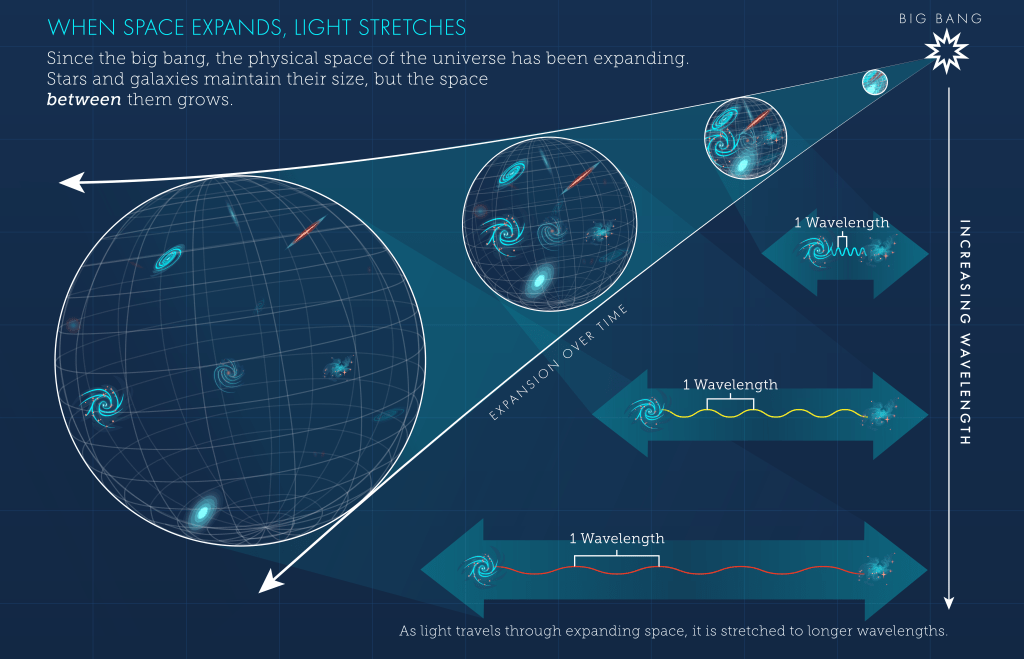
As mentioned above, Hubble’s discovery consists in the redshifts of the light emitted by remote galaxies, which depend on their distance from us. As space expands, the wavelength of electromagnetic radiation (or light in this case) travelling through this space also expands and becomes greater, thus shifting it towards the longer wavelengths. Importantly, such a phenomenon of a redshift is not accidental or limited to any local region; it is uniform across the entire observable universe. Therefore, it is not some sort of coincidence or regional phenomenon that happens only in our immediate vicinity.
Space-Time Expansion and Relativity
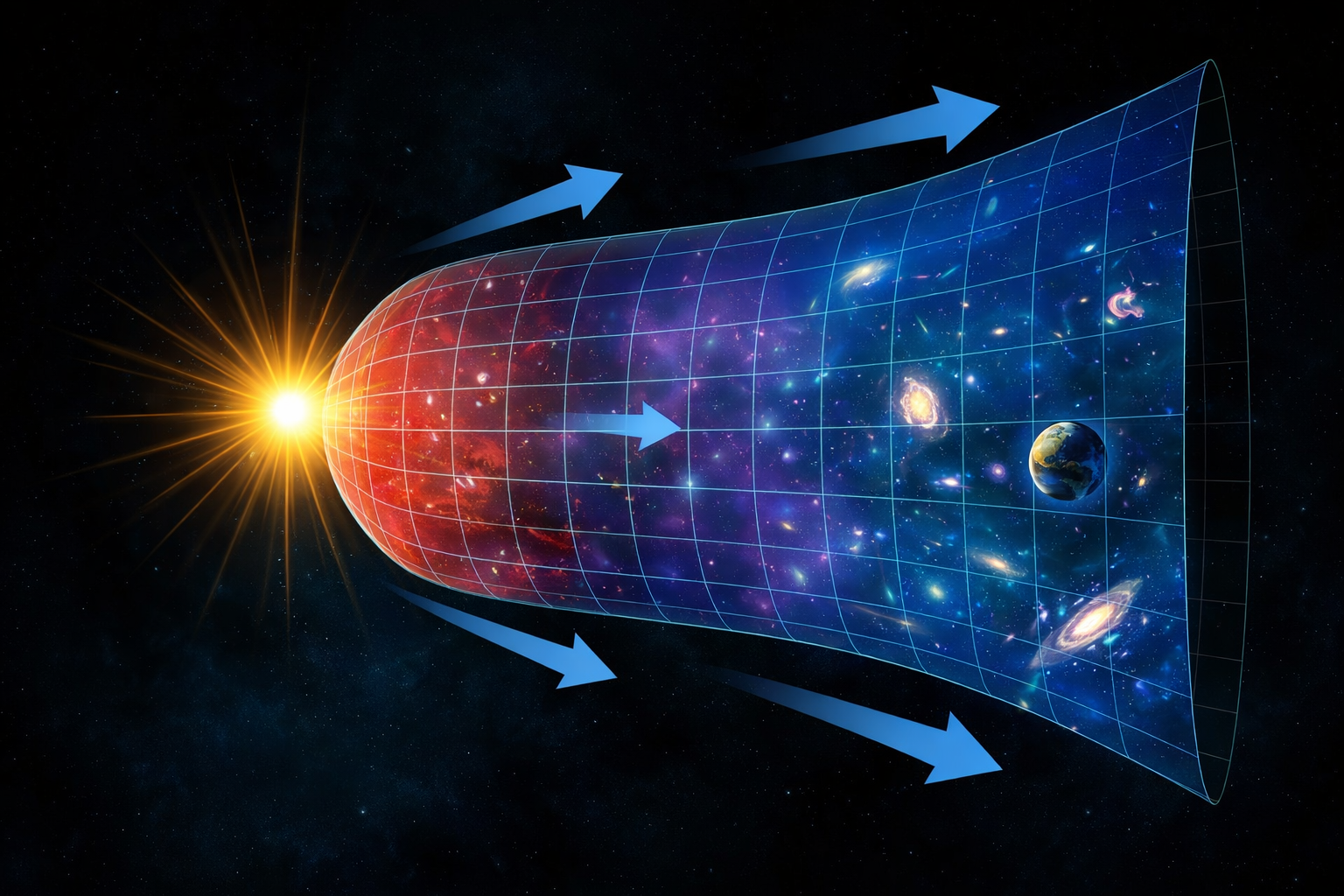
As we already saw, Hubble’s discovery can lead to the impression that galaxies move relative to Earth and other bodies in space. This is not entirely accurate. According to the theory of relativity, nothing travels through space faster than the speed of light. However, since it is space-time itself is expanding at this speed and is accelerating faster than the speed of light, this theory does not prevent the rate of expansion from being faster than the Hubble constant. It can therefore be concluded that this process is consistent with general relativity and special relativity.
Dark Energy
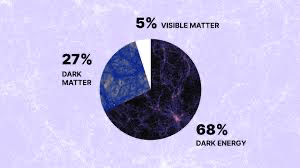
Until 1998, the majority of scientists thought that the expansion of the universe was slowing due to the gravitational attraction of different bodies. However, this is not true because in the late 1990s, it was discovered that the expansion of the universe actually accelerates, which required a special explanation. Thus, the concept of dark energy was introduced, which is supposed to push matter in the opposite direction, against gravity. Also, dark energy constitutes approximately 68% of all the energy in the universe. Even though it is one of the most important factors in modern cosmology and physics, we have not truly understood what dark energy really is.
Possible Scenarios of Death of the Universe
First, if dark energy maintains its level indefinitely, then the expansion of the universe will go on until it eventually dies of heat death. After the universe has expanded to a sufficient extent, most matter within it will dissipate, the stars will stop burning and explode, and eventually, the black holes will evaporate as well. Thus, the universe will reach a state in which there will be virtually no energy to sustain physical processes, nothing will change, and nothing can evolve.
Second, it may turn out that dark energy increases its intensity with time. In this case, eventually, its effect will exceed the forces of gravity. It will begin to disassemble galaxies and solar systems until atoms themselves start to split, which will destroy everything in the universe.
Third, dark energy can potentially weaken, in which case it will cease affecting the expansion of the universe, and gravity will prevail and contract the universe back into a point of singularity. However, this scenario is very unlikely to take place.
Conclusion
The expansion of the universe is one of the greatest cosmological and physical discoveries. Starting from Hubble’s observations of distant galaxies, we came to the realisation that the expansion of the universe is accelerating, powered by dark energy. However, while dark energy definitely exists, its nature and the laws governing its evolution are unknown. The death of the universe can occur in one of the many ways, ranging from heat death to the Big Rip.

 The Physics Phenomenon
Leave a comment