Introduction
People often think astronauts float because there is no gravity in space. That’s not true. At the height of the International Space Station, 400 kilometres up, gravity is still really strong. The real reason astronauts float is that they are in free fall while also moving at high orbital velocity. A long time ago, Isaac Newton explained this with a simple idea, before satellites even existed. It’s the idea behind orbital mechanics, the same physics that makes every orbiting satellite, moon and planet work.
Gravity in Orbit
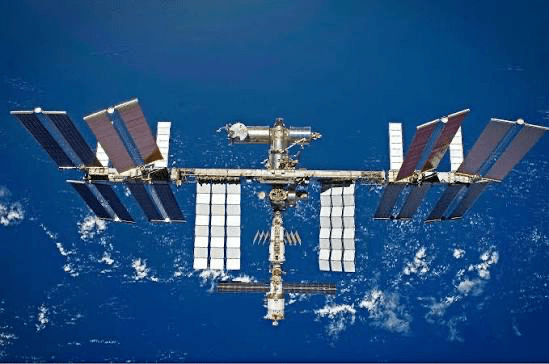
The ISS orbits 400 kilometres above Earth. That might seem far. It’s not that far compared to how big Earth is. Earth’s radius is 6,400 kilometres. At this height, gravitational acceleration is still about 90% of its surface value, around 8.7 m/s² compared to 9.8 m/s² on the ground. If gravity had actually disappeared there, the ISS wouldn’t be able to orbit. It would just fly off in a straight line at constant velocity, obeying Newton’s first law, and never come back. The fact that it goes around Earth every 90 minutes proves that gravity is still working. So if gravity is still pulling on the station, why do things inside it float?
Free Fall and Orbital Motion
The ISS is always falling towards Earth. What stops it from crashing is its tangential velocity. The station’s orbital velocity is about 28,000 kilometres per hour, roughly 7.8 km/s. This produces a centripetal acceleration that exactly matches gravity’s pull, so Earth’s surface curves away beneath it at the same rate it falls. It keeps falling. It keeps missing. This is what an orbit is. A fall that never lands. The Moon orbits Earth the same way. So does Earth around the Sun. An orbit is a free-fall trajectory with enough tangential velocity to never stop.
Newton’s Cannonball
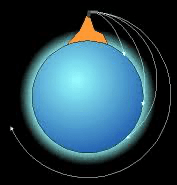
Isaac Newton figured this out a long time ago, before satellites existed. He imagined a cannonball fired horizontally from a tall mountain, ignoring air resistance. If it’s fired slowly, it lands close by. If it’s fired faster, it lands further away. Newton reasoned that at a precise orbital velocity, the cannonball’s free-fall trajectory would curve at exactly the rate Earth’s surface curves away from it. It would never land. It would just keep falling all the way around the planet.
Fire it faster still, beyond what’s called escape velocity, about 11.2 km/s for Earth, and the cannonball wouldn’t orbit at all. It would break free of Earth’s gravity completely.
This is Newton’s cannonball; the simplest way to understand orbital mechanics. Every satellite today is doing what Newton described, a long time before rockets were built.
Why It Feels Like Weightlessness
What astronauts experience is technically called microgravity, not zero gravity. The floating feeling astronauts get is like the drop you feel in a lift or on a roller coaster. For a moment, you and everything around you fall at the same rate, so there’s no normal force from the floor pushing on you. On the ISS, that moment never ends. The station and everything in it, including astronauts, are all falling together, all the time.
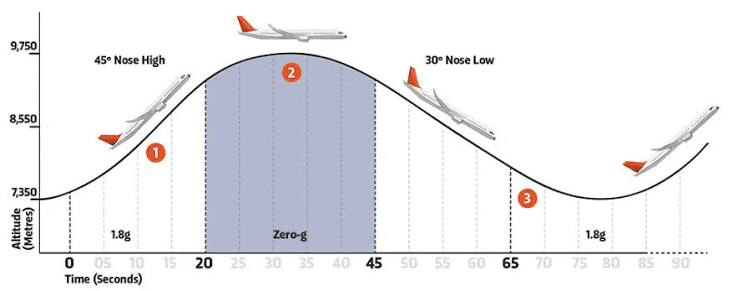
Astronauts actually train for this on Earth. They use aircraft called reduced-gravity planes. These planes follow a parabolic trajectory that creates free fall for about 20 to 25 seconds at a time. People call them “vomit comets.” They let astronauts experience microgravity before they go to space.
Conclusion
Gravity doesn’t switch off in orbit. What makes things float is free fall paired with enough orbital velocity to keep missing Earth instead of hitting it. Newton figured this out a long time ago, before anyone built a rocket. It’s the same sensation as a falling lift, just one that never stops. Astronauts aren’t escaping gravity, they haven’t reached escape velocity. They’re falling around the planet, on purpose, forever.



Leave a comment