Every bit of gold on Earth. Your ring, your phone’s parts, the fillings in your teeth. Was not made here. It also wasn’t made in the Sun. Making things heavier than iron needs a lot of energy, since iron sits at the peak of nuclear binding energy. So where did gold come from? For a time this was a mystery. The main idea needed a place that was very violent for atoms to gain neutrons, a process called rapid neutron capture (the r-process). Nobody had proof it happened anywhere. Then on August 17, 2017, we got it. From two stars crashing 130 million light-years away.
Two huge objects
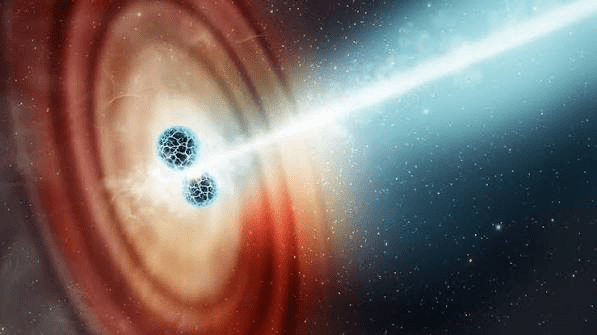
A neutron star is what’s left when a big star collapses hard that it turns into neutrons, the collapsed remnant left behind by a supernova. It’s 1.4 solar masses packed into a 20 km sphere. A teaspoon of it would weigh a billion tonnes on Earth. Now think of two of them born together moving closer over millions of years. They sent out gravitational waves and orbited faster until they finally collided.
The event that changed everything
LIGO (Laser Interferometer Gravitational-Wave Observatory) and Virgo caught that move as a rising sound in spacetime, a signal called GW170817. 1.7 seconds later satellites saw a burst of gamma-ray energy from the same spot. The first time a cosmic event was caught in both gravitational waves and light. About 70 observatories then looked at that spot in the galaxy NGC 4993, watching it for weeks across radio, optical, and X-ray wavelengths. This is called multi-messenger astronomy and GW170817 is its biggest example.
Nature’s gold maker
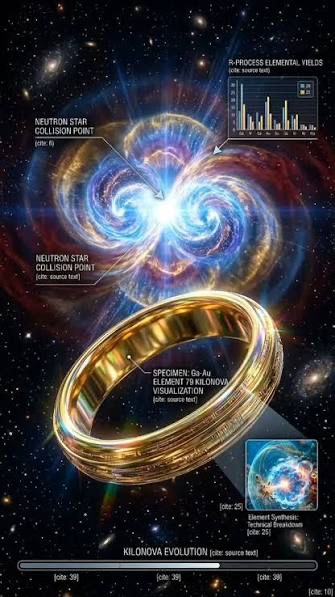
The crash sent out a cloud of debris moving fast, rich in free neutrons. Just what the rapid neutron capture needs. Neutrons hit nuclei fast, making isotopes in seconds. As the debris expanded and those isotopes got stable, the released heat made a glow astronomers call a kilonova. It started blue. Faded fast then turned red as heavy elements like gold and platinum took over. Exactly as the models said. Estimates put the heavy-element amount from this event at Earth-masses.
Still searching
As of mid-2026 GW170817 is still the neutron star merger caught with both a gravitational wave signal and a precise location. But the story keeps growing: in 2023 a burst of energy was linked to a kilonova with a sign of tellurium. In 2025 a strange event blurred the line between a supernova and a kilonova. Later this year the Vera Rubin Observatory starts scanning the sky nightly, hoping to catch the next kilonova by its light.
Why it matters
One 100-second signal let physicists test relativity, probe very dense matter, measure how fast the universe is expanding (the Hubble constant), and explain where some heavy elements come from. Not bad for a collision. And a reminder that the metal on your finger has a violent backstory.



Leave a comment